One of the biggest frustrations experienced SLPs run into is that they have a lot of knowledge about language therapy and a lot of materials and protocols accumulated, but they don’t have them organized in to a strategic system. They’ve tried, but often default back to planning session-to-session and doing things “on-the-fly”. If you’re an experienced clinician, you can get by with this approach, but you’ll eventually hit a ceiling.
Over time, this creates a pattern of stopping each time you convince yourself that this is the year you’ll finally find a better way to do language therapy. It feels like a time problem, when in reality it’s a structural one.
Most clinicians assume that building a better system requires a large block of uninterrupted time, such as a school break, during the summer, or when their schedule finally slows down. The problem is that those conditions rarely materialize in a way that allows for meaningful follow-through. And even when they do, the changes made during those bursts are often too large to sustain once the normal demands of the school year return.
The Asset Stacking concept works differently because it is designed to function within the constraints of a real school schedule, not outside of it. It starts with the assumption that you are not going to step away from your workload to build a system. Instead, you are going to build that system alongside your existing responsibilities, in a way that is gradual, repeatable, and sustainable.
Rather than waiting for the perfect opportunity, you intentionally create a recurring block of time that is dedicated to system-building. I call this strategy “Master Planning”, and I share how to do it in this article.
This block does not need to be large, but it does need to be consistent. What matters is not the duration, but the reliability. By treating this time as a non-negotiable part of your workflow, you create the conditions necessary for steady progress. Without protected time, system-building remains something that only happens in theory.
Once that time is established, the focus shifts from the “nuclear approach” of “blowing up” your entire system at once to making slow, strategic changes over time.
This is where most clinicians get off track, especially if they have a lot of knowledge about language and literacy. They attempt to redesign multiple aspects of their therapy at once, which quickly becomes overwhelming and difficult to sustain. Either that, or they get caught up in analysis paralysis thinking about all the different protocols they think they need to build, and they don’t get started at all.
Asset stacking prevents both the “nuclear approach” that often leads to burn-out or stopping and starting over and over again, as well as feeling so overwhelmed that you never get started. I give examples of how to implement Asset Stacking in this podcast episode, as well as this one.
Here is a visual that gives an example of two “Asset Stacks”.
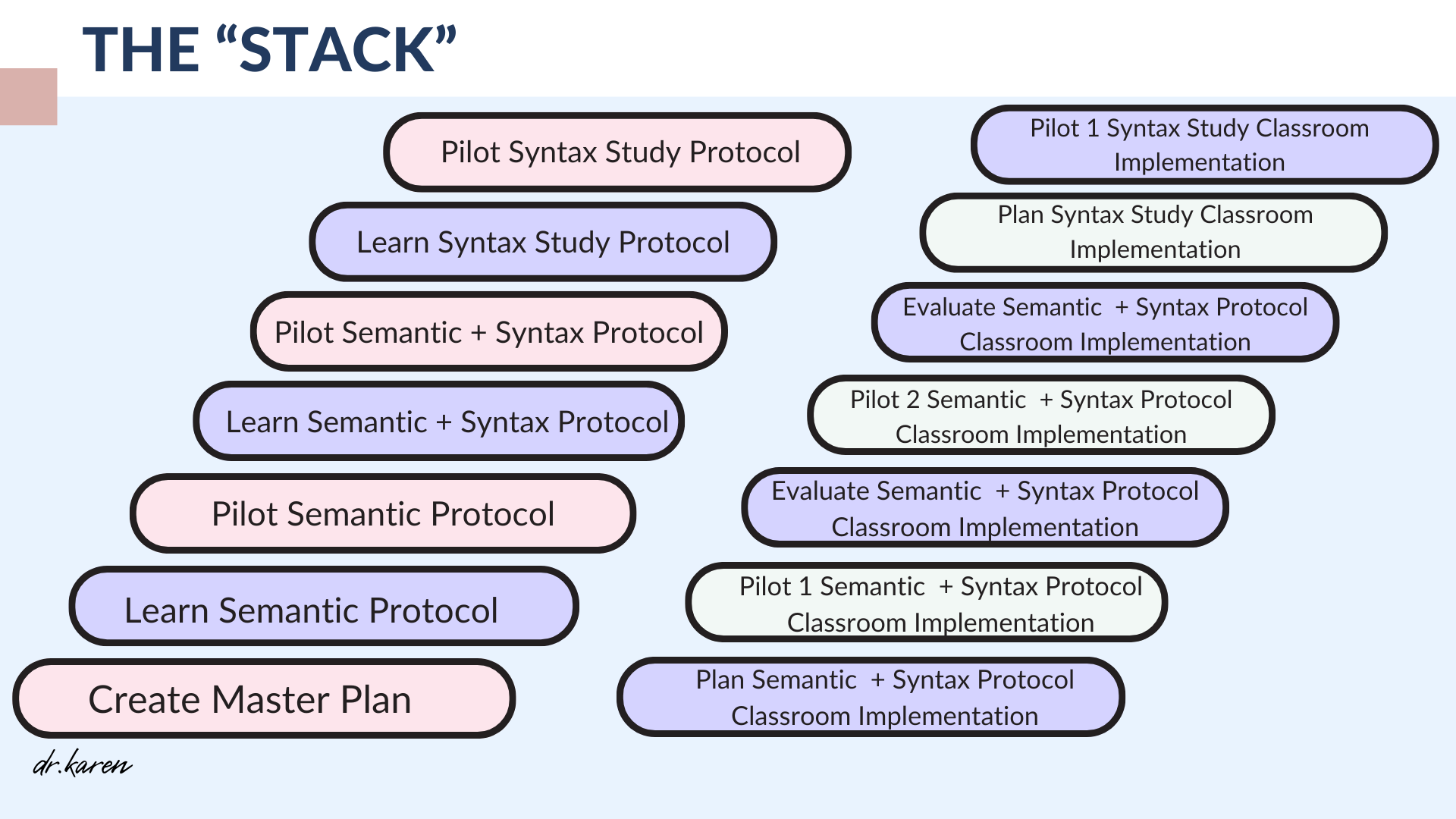
These two “stacks” give examples of how you would design a language therapy protocol using the “Essential 5” framework I describe in this article, using the concept of “Clinical Containers” that I outline here.
On the right side of the slide, you see that I start with the “Master Plan”, which will define which assets you’ll prioritize over the next 90 days. Then you’ll move on to using your protected “asset building” time for learning and researching your first protocol, which in this example is focused on semantic intervention. Once you’ve done your initial research, you can create your materials and move to a “pilot” phase where you’re testing it out with your students and refining. At this point, you have at least a working version of a semantic protocol that is not established and will take less effort to implement.
You can then repeat this process for additional protocols, such as in this example focusing on a hybrid semantics and syntax protocol, followed by one that does a deep dive in to syntactic structure. Over time, you can continued to “stack” and refine (revisiting prior assets if needed) until you have a complete, established system.
If you stack consistently in your direct therapy, you’ll eventually have a robust, streamlined system which will open up capacity for you to layer, or “stack” additional service delivery models such as coaching and consultation. You can use the protected time that you originally allotted to develop direct intervention protocols for collaboration because your therapy planning will be more efficient.
Clinicians often feel that they do not have time to incorporate additional service delivery models such as consultation or collaboration. What they are responding to, however, is not the concept itself, but the perceived need to implement it all at once. When viewed through the lens of stacking, these models become additional layers rather than separate initiatives.
The reason this approach is effective is that it aligns with how complex systems are developed in practice. They are not created in large, isolated bursts. They are built through repeated, protected execution over time. Each layer reduces the effort required to maintain the previous ones, which creates the capacity to add something new.
When clinicians say they do not have time to build a system, what they often mean is that they do not have a structure that allows their efforts to accumulate. Without that structure, every attempt at improvement feels like starting over. But if you stack assets strategically that are intended to fill “clinical containers” that you know are high priority, even small amounts of time can produce meaningful progress.
Asset stacking does not make your workload disappear. What it does is change the way you work to make it more intentional. Instead of resetting, it builds. And once that shift happens, the idea of creating a system no longer feels like something you have to find time for. It becomes something that develops as a natural extension of the work you‘re already doing.
If you enjoyed this article I invite you to sign up for my free training called, “Three Shifts to Creating a Scalable Language Therapy System” session.
In this session I reveal:
- How to stop chasing an endless list of language goals and start organizing therapy into defined “containers”.
- 5 linguistic components that create a therapy structure you can adapt across K–12 to support language and literacy.
- Why experienced clinicians struggle to create a “language therapy system”, despite being highly skilled at direct intervention.
- Create a master plan that helps you steadily build your therapy system instead of searching for the “perfect curriculum.”
You can sign up for this free online session here.